There is a particular kind of suffering that comes with Body Dysmorphic Disorder that most people never talk about — not because it is too painful, but because it does not seem like a disorder at all.
It seems like the truth.
When I was in the depths of BDD, I did not think I was mentally ill. I thought I was ugly. I thought my appearance was genuinely as flawed as I perceived it to be, and that my distress was a reasonable response to something real. I had no framework for understanding that my mind was lying to me — and lying convincingly, relentlessly, in a way that organized my entire life around managing a threat that no one else could see.
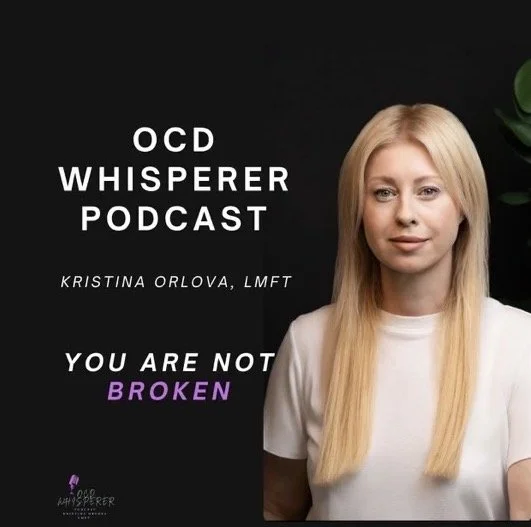
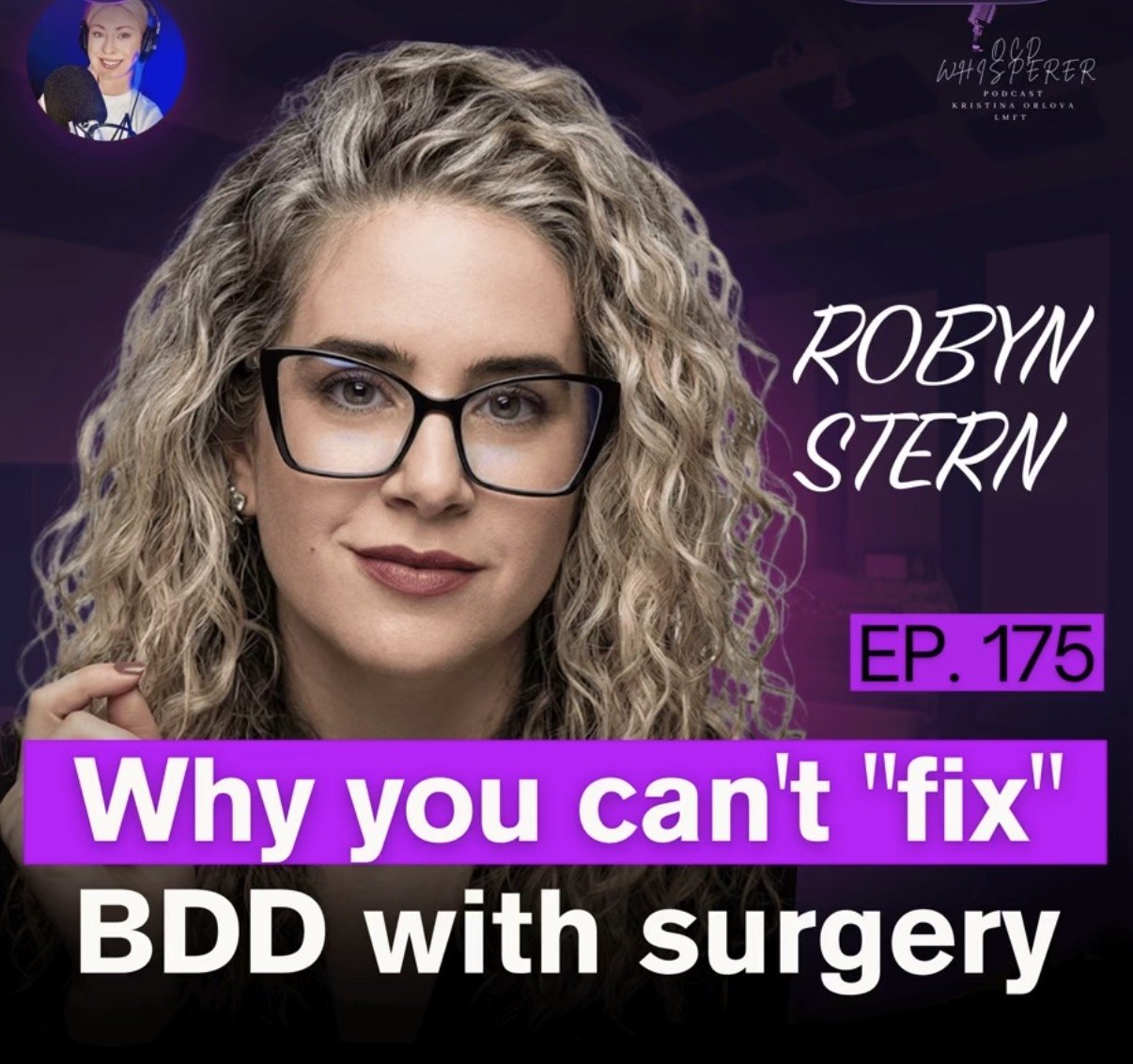
That experience (and what it took to get to the other side of it) is what I sat down to talk about with Kristina Orlova on The OCD Whisperer Podcast this week.
Before I Knew It Was BDD
One of the first questions Kristina asked me was what I thought was wrong with me before I had a name for it.
The honest answer is: I thought I was just insecure. Anxious, maybe. Vain, possibly. I had been to therapists before my diagnosis who treated me for depression and anxiety — and while those were real parts of my experience, they were symptoms of something more specific that was never identified or addressed.
The appearance-based preoccupation was so private and so shame-laden that I never brought it into the room. I did not think of it as the center of what I was dealing with. I thought of it as a personal failing — something too embarrassing to name out loud — rather than a clinical condition with a profile, a treatment, and a path out.
This is one of the cruelest features of BDD: the shame of it keeps it hidden, which keeps it untreated, which keeps the shame alive.
The Wallflower Experience
I describe what those years felt like as the "wallflower" experience — functioning on the outside while suffering deeply on the inside.
To the people around me, I appeared to be managing. I showed up. I performed. I was capable in the ways I needed to be. But internally, my mind was consumed by something no one else could see or understand. There was a version of me that existed in public, and a version of me that lived inside the disorder — and those two versions shared almost nothing.
This is something I see constantly in my clinical work. The people who come to me for BDD and OCD treatment are not, in most cases, visibly falling apart. They are high-functioning by most external measures. They hold jobs, maintain relationships, meet their responsibilities. The suffering is private, internal, invisible — which is exactly why it goes on for so long without being addressed.
Why a Medical Result Did Not Fix It
Something I shared in the episode that I think is important to name explicitly: getting clear skin did not fix how I saw myself.
I went through a course of Accutane. My skin cleared. And the image in my mind did not change.
This is a pattern I have seen repeatedly in clients who have pursued cosmetic treatments or medical procedures hoping to resolve their BDD. The appearance changes. The disorder does not. In many cases it intensifies — either because the original concern is now "gone" and a new one emerges, or because the relief of the procedure was temporary and the intrusive doubt came flooding back.
This is why BDD is not a dermatological problem or a cosmetic problem. It is a psychiatric condition, and treating the appearance will not treat the disorder. The mirror is not the problem. The mind's relationship to what it sees in the mirror is the problem.
What Treatment for BDD Actually Involves
Kristina asked me directly what the actual therapy looks like — and specifically how BDD treatment differs from standard OCD treatment.
The foundation is the same: Cognitive Behavioral Therapy and Exposure and Response Prevention. ERP addresses the compulsive behaviors — the mirror checking, the reassurance seeking, the comparing, the camouflaging — that maintain the cycle of doubt. Each compulsion provides temporary relief and teaches the brain the threat was real, which is why the doubt always comes back stronger when you engage with it.
But BDD requires something beyond what standard ERP alone provides. The shame is deeper. The core beliefs about worth and identity are more entrenched. A person can stop checking the mirror and still be walking around with the same foundational belief that there is something fundamentally defective about who they are. Behavioral interruption alone does not reach that.
The work that actually produces lasting recovery involves addressing those underlying beliefs directly — understanding where they came from, what they have been protecting, and how to build a more stable relationship with your own sense of self that is not organized around appearance. It requires healing the inner wounds, not just interrupting the outer behaviors.
This is what I mean when I talk about value-based living as the goal of recovery. Not just freedom from compulsions. A life that has something in it — relationships, goals, joy, community, meaning — that is no longer organized around managing a perceived flaw.
How Can You Have a Relationship When You Are in a Relationship With a Body Part?
One of the questions in the episode that I think deserves its own conversation is this one: how can you be present in a relationship with another person when your mind is consumed by a relationship with a body part?
The answer, in short, is that you cannot — not fully. BDD does not just affect how you see yourself. It affects your capacity for intimacy, connection, and presence. When a significant portion of your cognitive and emotional bandwidth is devoted to monitoring, managing, and hiding a perceived flaw, there is very little left for genuine relational engagement.
This is one of the reasons recovery is not just about symptom reduction. It is about reclaiming the capacity to be present — with other people, with experiences, with your own life — in a way that BDD had quietly taken away.
Recovery Is Possible — and It Looks Like a Life
I want to be direct about something: BDD is a chronic condition, but it is not a permanent sentence.
Recovery does not mean the absence of intrusive thoughts about appearance. It means a fundamentally different relationship to those thoughts — one where they arise and you are no longer compelled to check, compare, hide, or neutralize them. You can be in the world. You can be seen. The thoughts lose their charge.
What recovery looks like, in practice, is a life. Hobbies you had given up. Relationships you had been avoiding. Goals you had put on hold because the disorder had made functioning feel impossible. A daily existence that is no longer organized around managing something no one else can see.
I know this is possible because I lived it. And because I have watched clients live it.
If You Are Recognizing Yourself in This
If what I have described here — the private suffering, the functioning on the outside, the appearance-based preoccupation that feels like fact rather than thought — sounds familiar, I want you to know that what you are experiencing has a name, and it responds to the right kind of treatment.
A free 15-minute consultation is a no-pressure way to talk about what has been going on and find out whether working together makes sense. You do not have to have it figured out before you reach out.
Watch the full episode on The OCD Whisperer Podcast here →
Book a Free 15-Minute Consultation →
Robyn Stern, LCSW is a licensed therapist specializing in OCD, BDD, and related conditions, with lived experience from the inside. She provides teletherapy to clients in New York, California, Florida, Connecticut, and New Jersey.
